InfoQ 中文 · 10/10/2026, 15:23:05
OpenAI Launches Decisions API on GPT-6 Luna for Millisecond Discrete Choices, Threatening Jev's Market Position
OpenAI introduced the Decisions API at DevDay, leveraging its smallest model, GPT-6 Luna, to perform discrete choices from preset options with a latency of just 150 milliseconds. Designed as a high-frequency, low-cost component for agent workflows, this feature directly overlaps with the core capabilities of startup Jev, raising concerns about the latter's viability. The API is currently in limited preview, with pricing and capacity details yet to be fully disclosed.
SOURCE COVERAGEFull Original Report
Contents2 sections

Just 15 days after Jev’s launch, OpenAI entered the arena.
At today’s DevDay, OpenAI unveiled its new Decisions API. Built on GPT-6 Luna—currently OpenAI’s smallest and most cost-effective model—it makes selections from a set of predefined answers and returns corresponding confidence scores. OpenAI reports a latency of 150 milliseconds, compared to 1.6 seconds when using GPT-6 Luna directly for similar tasks.
Developers only need to provide the API with a question, candidate answers, and context. Instead of generating text like ChatGPT, the model outputs a decision ready for programmatic use: which category content belongs to, which model should handle a request, or what action an Agent should take next.
This capability is almost exactly what has made Jev the center of attention over the past two weeks.
Hours after the announcement, a post titled simply “Jev Is Dead” appeared in Reddit’s AI_Agents subreddit.
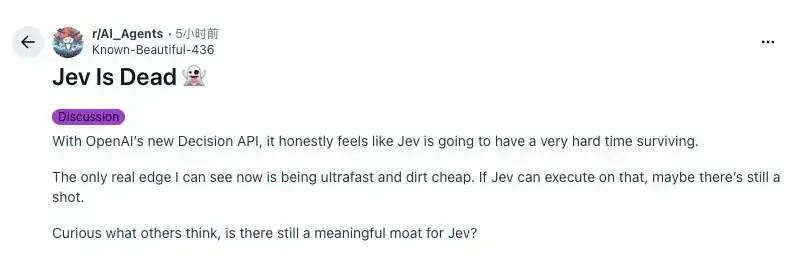
The poster wrote that with OpenAI’s release of the Decisions API, it would be extremely difficult for Jev to survive. Its remaining advantages are now limited to “extreme speed and low cost.” In the comments, another user added a blunt assessment: “Jev never had any moat to begin with.”

What OpenAI Released Is Essentially a Jev Clone
During the DevDay keynote, Sam Altman introduced the Decisions API with just a few sentences: “Today, we’re launching the Decisions API. It allows models to respond in fractions of a second—extremely fast. The way it works is by providing the Luna model with a set of predefined options. By focusing the model solely on making this choice, we can maximize response speed.”
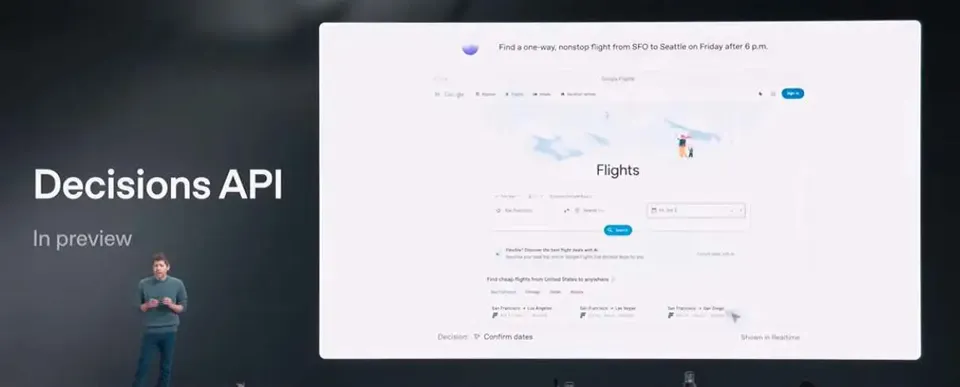
This statement contains two key pieces of information.
First, the Decisions API narrows open-ended generation down to “making a selection from explicit options,” which aligns closely with the design philosophy behind Jev’s Choice primitive.
Second, it uses Luna as the underlying model—the smallest and cheapest option in OpenAI’s current lineup. Choosing the minimal, lowest-cost model for decision-making tasks, rather than invoking Astra or GPT-6.1 Sol, clearly signals that this feature targets high-frequency, low-cost scenarios where it can be embedded at scale into Agent workflows.
The new API is currently available only as a limited preview. Pricing, the maximum number of candidate answers per request, and whether developers can fine-tune the model with their own data have not been disclosed. An OpenAI spokesperson told media outlets that more details will be released “upon general availability.” This suggests OpenAI likely rushed the announcement to coincide with DevDay.
This product fills the gap between standard chat models and traditional classifiers. Previously, if developers wanted a model to choose among several options, they typically called a standard chat model and used prompts to force it to return only one specific option. If confidence scores were needed, they could read token probabilities or ask the model to generate a numerical score. However, confidence estimates from chat models are often rough approximations, and completing a simple judgment might require generating a large number of tokens.
The alternative approach was training dedicated small classifiers. These models are fast and cheap but require labeled training data. If classification labels change, the model usually needs retraining.
The Decisions API sits between these two extremes. Developers can use it like a large language model, providing new questions and labels via prompts, while receiving structured results and confidence scores similar to those from a classifier. This design isn’t entirely new for OpenAI: the Moderation API has long returned scores for predefined categories. The difference is that the Moderation API’s categories are fixed by OpenAI, whereas the Decisions API allows developers to define their own questions and candidate answers.
This product logic overlaps significantly with Jev.
On September 15, TypeSafe AI officially launched Jev. According to the Financial Times, Jev quickly attracted investor interest after its release, with potential investments being discussed at a valuation exceeding 200 million.
Diogo Almeida, the mind behind Jev, previously worked at OpenAI on GPT-4, ChatGPT, and RLHF/InstructGPT. In a recent talk, he introduced himself as follows: “I co-authored some of OpenAI’s most significant public achievements, including GPT-4, ChatGPT, and RLHF/InstructGPT. My team essentially created the concept of ‘post-training.’” He added, “But what really sets me apart is that I’m probably one of the few people at OpenAI who publicly criticizes ChatGPT.”

TypeSafe claims that Jev is 20 to 200 times faster than frontier large language models on comparable structured tasks, at only 1/40th to 1/400th of the cost. The price is $0.042 per million input tokens, with output tokens free.
Currently, only product form and response speed can be directly compared; pricing, calibration methods, and real-world accuracy remain unknown. However, the directions outlined by both companies are highly aligned: developers define questions and candidate answers, the model quickly returns a selection and confidence score, and these results are embedded directly into classification, routing, and Agent decision-making workflows.
Where Is the Moat?
Jev’s architecture itself likely does not constitute a moat.
Although TypeSafe has not disclosed Jev’s complete architecture or specific implementation, we can observe that multiple early clones are built upon existing large language models. Bespoke Nimble is based on Qwen3.5-9B fine-tuned via LoRA, trained using synthetic contrastive data, and returns probabilities by reading the logits corresponding to candidate answer tokens. The smaller Kev-0.5B adds a LoRA adapter and a small pointer head on top of Qwen2.5-0.5B, allowing it to run locally on a MacBook Pro.
While the specific implementations of these reproductions differ, their core approach is similar: enabling the model to score a set of explicit candidate answers without generating full text. One possible implementation involves providing a state and a set of questions, where the model calculates only the options that could become the next token along with their probability distribution, then converts the logprobs of the candidate tokens into structured results.
Taking Noul as an example, the model only needs to focus on the two tokens representing true and false, ignoring all others. By normalizing the probabilities of these two tokens, it derives the probability of "yes" or "no." Choice operates similarly: if a developer provides four candidate answers, the model compares the relative probabilities of the four corresponding tokens to form a complete probability distribution and returns the option with the highest probability.
Based on this, John Berryman, founder of Arcturus Labs, judges that the model used by Jev may be very close to traditional large language models. LLMs inherently assign probabilities to all possible values for the next token. What Jev likely does is narrow this capability to a set of explicit options and convert the internal token probabilities into decision results that developers can use directly.
If the architecture is not the moat, the true barrier to entry likely lies in training data and training processes. Raw data is not scarce; the difficulty lies in transforming real-world cases with clear outcomes into materials suitable for training decision models, and then using reinforcement learning to align the model’s predicted probabilities with actual accuracy. This aligns with Almeida’s statements regarding data and architecture.
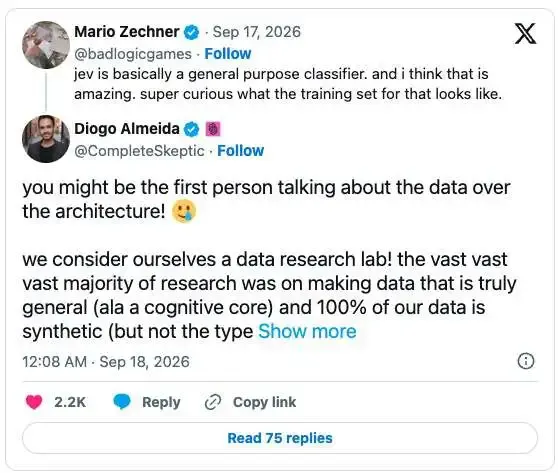
These cases can come from entirely different domains, such as customer service tickets and their actual routing departments, resumes and whether candidates were ultimately hired, product reviews and their star ratings, content moderation queues and final rulings, and prediction markets and their eventual outcomes. They share the same training objective: given a specific context and limited options, enable the model to reconstruct what actually happened. How to transform these cross-domain cases into unified training materials, and train a model capable of generalization and probability calibration, is likely the aspect of TypeSafe that is hardest to replicate.
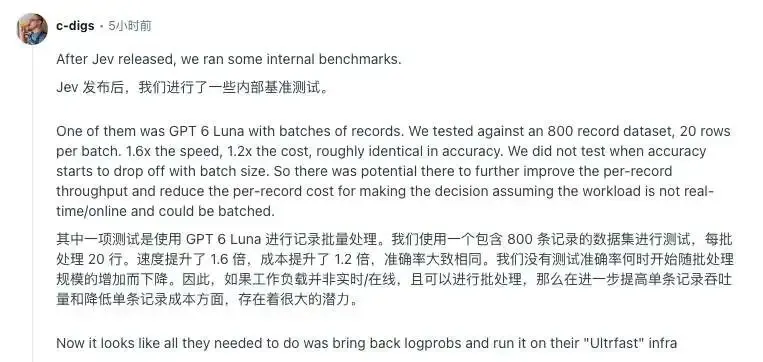
Many Reddit users agree with the view that "Jev has no moat whatsoever." One user shared their internal testing results: using GPT-6 Luna to process a dataset of 800 records, with batches of 20 inputs each. According to them, GPT-6 Luna was 1.6 times faster than Jev, 1.2 times more expensive, and had roughly the same accuracy.
Moreover, OpenAI possesses an advantage that TypeSafe will find difficult to replicate quickly: it already has a massive developer platform, along with products like Dots, Space, Codex Cloud, and computer operation APIs. Although OpenAI has not yet announced integration between its Decisions API and these products, once its accuracy reaches usable levels, it can rapidly reach developers through its existing platform.
For many teams, it doesn’t necessarily need to outperform Jev on every metric. As long as it is sufficiently accurate, priced comparably, and eliminates the cost of integrating a new vendor, it is already highly attractive.
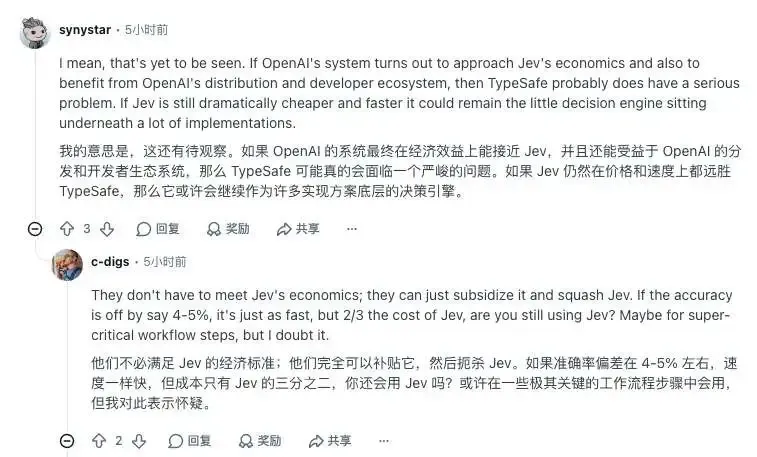
If this moat is shallow, and OpenAI also builds one, will TypeSafe’s window of opportunity close rapidly?
Interestingly, Almeida himself seems unbothered. In an interview with Latent Space, he stated: "If model quality really matters, we will be in a very favorable position for a long time."
Whether this statement holds depends on the hardest variable to verify: how accurate are the probabilities provided by Jev? If TypeSafe’s training data and reinforcement learning pipeline are difficult to replicate, Jev still retains its place. If OpenAI can quickly approach its accuracy and then leverage price, platform, and developer ecosystem to scale, TypeSafe’s window of opportunity will shrink rapidly.
Reference links: