新智元 (微信公众号) · 10/7/2026, 18:47:00
Mistral Releases Open-Source 1-Trillion Parameter Large 4: Matches GPT-6 Intelligence and Surpasses Closed Models in Vertical Tasks
French AI unicorn Mistral has released its flagship model, Mistral Large 4, featuring 1 trillion total parameters with weights scheduled for full open-source release by month-end. The model scored 38 on the Artificial Analysis intelligence index, matching GPT-6 Luna, and significantly outperformed GPT-6 Astra and Claude Opus 5 in specific benchmarks including legal, financial, and cybersecurity vulnerability repair tasks. Backed by Europe's largest equity funding round, this move aims to challenge closed-source giants' monopoly on high-end compute and model capabilities through an open-source strategy.
SOURCE COVERAGEFull Original Report
Trillion-Parameter Model Goes Open Source Overnight
Just now, Europe’s strongest AI has returned!
French AI unicorn Mistral suddenly released its new flagship, Mistral Large 4. With a total of 1 trillion parameters, the weights will be fully open-sourced by the end of the month.
In Artificial Analysis’s Intelligence Index, it scored 38 points, matching GPT-6 Luna.
This makes it the top-ranked open-source model in the West; the second-place Thinking Machines’ Inkling only scored 25 points. In Artificial Analysis’s words, outside of China and the US, it is the smartest model globally.
It even outperformed GPT-6 and Claude on several hardcore benchmarks:
- Its score on legal agent tests was nearly 3 times that of GPT-6 Astra
- It beat GPT-6 Astra in finance and visual grounding tasks
- It won against Claude Opus 5 in scientific programming
On a cybersecurity exam question involving vulnerability patching, it achieved an 82% success rate—the highest among all models. Claude Opus 5.5 and GPT-6 Astra refused to answer, essentially submitting blank papers.
Where closed-source giants refuse to take on tasks, this "fat cat" (Mistral) accepts them all.
The Exam Question Where GPT-6 Failed, It Scored 82%
For a security engineer fixing a vulnerability, the first step must be to reproduce the attack. Without reproduction, you cannot confirm where the vulnerability lies, nor verify if the patch actually works.
So while "reproducing vulnerabilities" sounds like malicious activity, it is actually the first half of the remediation process. If a model refuses to answer upon seeing "reproduce vulnerability," it effectively discards the second half of the solution as well.
Across the entire cybersecurity index, Mistral Large 4 succeeded 50 times, ranking in the global top five.
GPT-6 Astra succeeded 33 times but was blocked by its own safety mechanisms 38 times. Claude Opus 5.5 succeeded 29 times but was blocked 36 times.
For both closed-source flagships, the number of refusals exceeded the number of successes.
Mistral stated directly in its blog post that the blanket refusal policies of OpenAI and Anthropic are blocking legitimate vulnerability research and incident response.
Hackers have long been jailbreaking closed-source models to aid their attacks, while defenders are tied down by the same refusal mechanisms.
More critically, having a model’s capabilities abruptly withdrawn mid-incident response creates a significant security risk in itself.
In contrast, Mistral Large 4 does not get stuck on refusals.
On Cybench, which includes 40 real-world CTF (Capture The Flag) security competition questions, it solved 93%.
In a set of 19 internal cybersecurity challenges at Mistral, it solved 16.
In internal tests, it demonstrated the ability to analyze malware, prioritize vulnerabilities, and write detection rules—tasks for which it had no specific training.
Mistral fed it a CobaltStrike loader commonly used by hackers for malicious purposes, with no labels attached and no human intervention throughout the process.
It decompiled the binary itself, traced its way to named pipes, uncovered the hidden encrypted payload, and ultimately broke the XOR encryption.
Meanwhile, when facing jailbreak attacks and malicious Agent tasks, its refusal rate is higher than that of all open-source models.
In Lakera's publicly available B3 AI security benchmark, it blocked 93.3% of attacks—a score no competitor surpassed.
From Coding to Satellite Imagery Analysis: A Versatile Performer
The ability to reproduce vulnerabilities and patch them manually relies on strong coding capabilities.
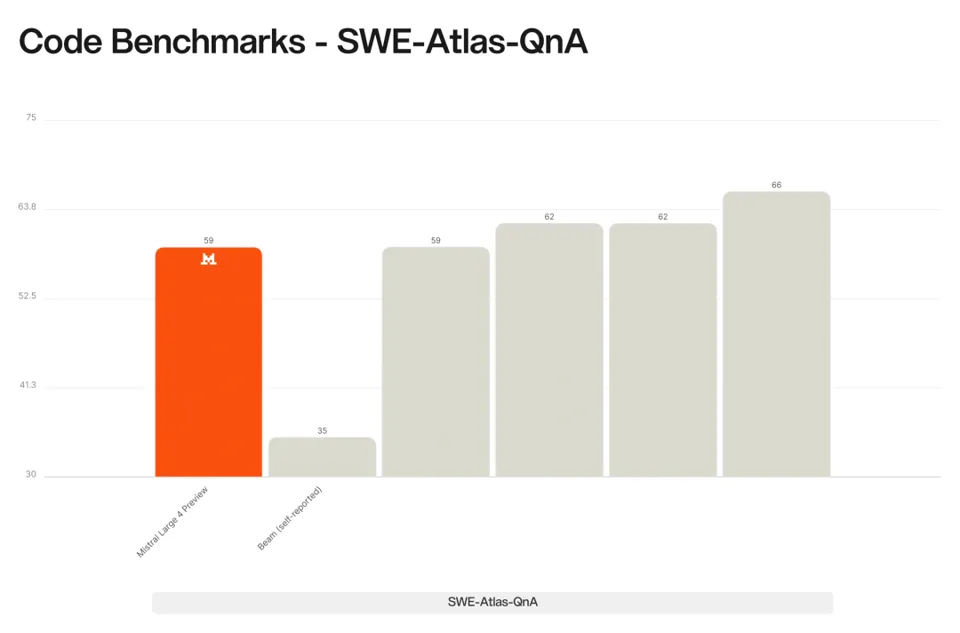
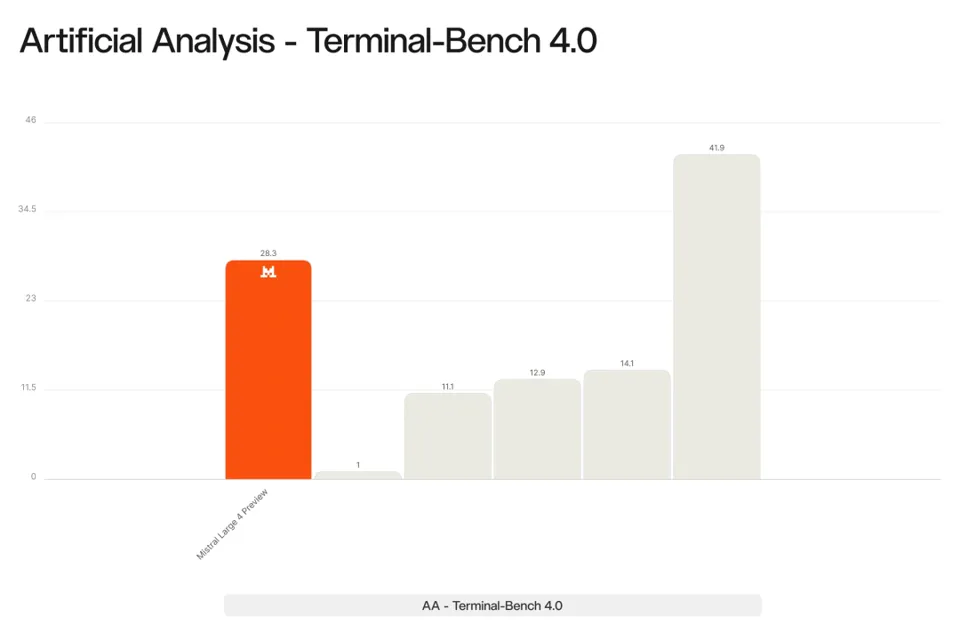
In terms of pure coding performance, it achieved 61.7% on DeepSWE v1.1, 59.4% on SWE-Atlas-QnA, and 28.3% on Terminal-Bench 4. Its overall programming Agent index reached 49.8%, outperforming two top-tier open-source models.
Swipe left or right to view more
AutomationBench includes 657 real-world business workflows, requiring the model to switch seamlessly between Gmail, Google Sheets, Slack, and Salesforce to complete tasks step by step. Mistral Large 4 scored 59.9% on this benchmark.
AA-Briefcase evaluates long-horizon knowledge work such as creating spreadsheets, editing presentations, and generating PDFs. Mistral Large 4 achieved an Elo rating of 1393 in this test.
Third-party evaluation firm Vals AI tested the model using real legal and financial tasks, where Mistral Large 4 outperformed GPT-6 Astra. On Harvey's legal Agent benchmark, a leading legal AI company, it surpassed all open-source models.
Beyond coding, law, and finance, it also excels at image analysis.
In gigapixel-scale satellite imagery, it can meticulously locate targets, helping disaster relief teams save critical time; when analyzing engineering blueprints, it can iteratively zoom in, inspect, and verify components until the answer is accurate.
Show it an assembly diagram of a vacuum flip gripper and ask whether the compression spring will interfere with the sliding bearing. It locates both components in the image and answers "no," because Vacuum Pin No. 3 sits between them.
On the Dense 200 visual grounding benchmark, it scored 42%, edging out GPT-6 Astra's 41.5% and even surpassing closed-source flagship models.
On the SciCode-Verified scientific programming benchmark, it achieved 91.8%, the highest score among Western open-source models, outperforming Claude Opus 5's 91.3%.
In real-world research scenarios, it can generate complete Hartree-Fock simulation code in one go. This is a quantum chemistry method for calculating molecular electronic structures, requiring a long chain of complex computational steps.
Training a "Chonk" from Scratch on 3,800 Blackwell GPUs
Mistral officially codenamed this model le Chonk.
"Chonk" is internet slang for an extremely large, chubby cat. CEO Arthur Mensch embraced the meme on X, clarifying that it actually means "le gros chaton"—a big fat kitten.
And it really is massive.
With 1 trillion total parameters, it uses a Mixture-of-Experts (MoE) architecture. Only 49 billion parameters are activated per generated token, ensuring high throughput despite its size.
It integrates instruction following, reasoning, and agentic capabilities into a single model, supporting over 160 languages, including all official EU languages.
Mistral trained it from scratch using 3,800 NVIDIA Grace Blackwell GPUs in its own European data centers. The currently available preview version also runs on this same hardware cluster.
Post-training relies on large-scale reinforcement learning.
An auto-scaling cluster simultaneously runs tens of thousands of trials, with individual task trajectories consuming millions of tokens. The model learns from the outcomes of each attempt.
At current scale, training generates 33 billion tokens per day, with approximately 16 billion remaining after filtering for direct use in training.
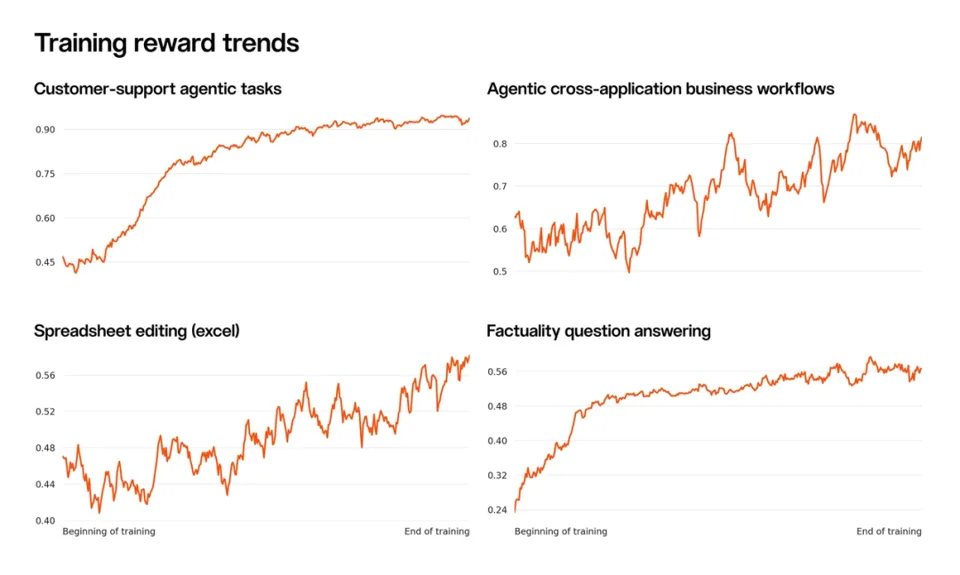
Training rewards continue to rise across four key task categories: customer service agents, cross-application business workflows, Excel spreadsheet editing, and factual question answering.
Moreover, this round of reinforcement learning is not yet complete, and there are no signs of performance saturation. Mistral states that significant, rapid improvements are expected over the coming weeks and months.
While the model is still being trained, the preview API is already live on Mistral Studio, priced at 4.18 per million output tokens.
Full weights will be released by the end of the month, allowing enterprises to deploy the model in private clouds or install it directly in their own data centers.
Handing Control of the Trillion-Parameter Brain Back to Users
As we move closer to Artificial Superintelligence (ASI), the more tasks models can perform, the more critical it becomes to decide "who controls what they can do."
For the past two years, these decisions have been embedded in the safety policies of several closed-source vendors. If GPT-6 and Claude refuse to address a specific vulnerability due to policy restrictions, security engineers relying on them are forced to stop working.
Mistral Large 4 hands over a trillion-parameter brain capable of competing with closed-source flagships, along with full control switches.
With weights in your possession, you decide where the model is deployed and when it is used. You are no longer subject to vendor dictates, nor risk having access abruptly cut off at critical moments.
And this is just an unfinished preview version.
Mistral holds €3 billion in Series D funding, the largest equity financing in European tech history. These funds are being used to expand compute capacity in its own European data centers. Mistral Large 4 is merely the first milestone on this roadmap.
References:
https://mistral.ai/news/mistral-large-4/
Chasing ASI in Seconds
⭐ Like, Share, and Watch One-Click Combo ⭐
Star us to lock in instant updates from New Intelligence!