量子位官网 · 10/9/2026, 16:47:34
Aether AI Unveils CRIS-0: Causal Reasoning Enables 0.2s Emergency Stops and Second-Level Replanning in Robots
Aether AI has launched CRIS-0, an embodied intelligence system that integrates causal reasoning to address the brittleness of traditional robots when facing unexpected disturbances. In the Coffee Preparation benchmark, the system identified changes in causal variables and executed real-time replanning within an average of 2 seconds, achieving a 9/10 recovery rate under random perturbations while enabling local corrections instead of full restarts. This marks a significant step for causal AI moving from theory to physical deployment, enhancing robot robustness in unstructured environments.
SOURCE COVERAGEFull Original Report
Jay from Aofeisi QbitAI | Official Account: QbitAI
0.2 seconds.
This is the time it takes for a robot to emergency hover when closing a microwave door, triggered by a human hand suddenly inserting itself into the path.
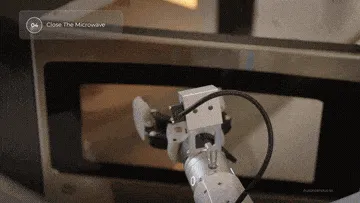
There’s even more impressive behavior.
When a metal soda can is mixed in with a cake plate being carried toward the microwave, the robotic arm first picks out the can and sets it aside. Only after confirming the plate is safe does it proceed to place the plate inside the oven.

Honestly, watching these demos left me momentarily stunned.
Those who have followed embodied AI closely will likely resonate with this observation: many robots look flashy, but most of the time they are merely "memorizing answers." The moment lighting changes, an object gets kicked, or a command carries subtle implicit intent, the robot instantly loses its footing.
Yet, even if you shine a flashlight directly into the robot's "eyes" as seen in the video, it remains completely unfazed...
However, the scenes shown above are not pre-recorded action replays, nor are they lucky guesses based on statistical correlations.
Facing continuous unexpected disturbances, the system real-time inferred this sequence of actions based on an understanding of causal laws governing the physical world.

The system driving this robot is codenamed CRIS-0.
Behind it lies Aether AI, a causal intelligence company founded by Biwei Huang, an Assistant Professor at UC San Diego (UCSD) and a scholar from CMU’s causal inference school.
Three months ago, QbitAI reported on Aether AI’s chosen path of causal intelligence. At that time, many believed causal AI was still confined to mathematical formulas and thought experiments.
Now, Aether AI has released official demos.
Goodbye Mechanical "Blindness": Robots Learn to Understand Causality
In embodied robotics deployment scenarios, what engineers struggle with most has never been standard procedures, but rather the ubiquitous unexpected events.
Traditional robots facing sudden disturbances either mechanically repeat old coordinates leading to collisions, or simply error out and freeze the entire process. End-to-end black-box models, especially in long-horizon tasks involving dozens of steps, are prone to cumulative errors; one misstep can cause the entire plan to collapse.
CRIS-0’s breakthrough solution lies in "causality"—
Moving the robot from "seeing what happens" to "understanding why it happens and how changes affect outcomes."
Let’s look at the performance metrics.
In the Coffee Preparation test involving external sudden interference, the robot encountered manual displacement of the coffee machine and abrupt lighting changes while grasping it. CRIS-0 identified changes in causal variables and completed real-time re-planning within an average of 2 seconds, achieving 9 effective recoveries out of 10 random perturbations.
Moreover, it doesn’t blindly restart the entire process.
When the coffee machine is pushed away, the system tracks the key causal variable: "handle relative pose." Upon detecting a shift in this variable’s state, it only corrects the approach and grasp phases, without needing to return to the original position and restart.
Resistance to interference is just the baseline. In long-horizon autonomous tasks, the advantages of causality-driven systems become even more pronounced.
In complex multi-step tasks like "Living Room Object Search and Organization," the system decomposes long-term goals into atomic, verifiable causal stages, performing pre-condition and post-condition checks at every step.
Even more interesting is CRIS-0’s demonstration of common-sense reasoning and physical perception capabilities:
While clearing a table, it organizes scattered ordinary books onto the coffee table but stores bills containing personal privacy information into a drawer.
Faced with two visually similar beverage cans, it first perceives the can’s weight and internal liquid status by shaking it upon grasping. It only throws the can into the trash after confirming it is empty; if it senses unfinished drink, it carefully places it back in its original position.
Finally, when dealing with ambiguous requests, causality significantly improves prompt generalization, thereby enabling personalized understanding.
In the Personal Pick and Place test, faced with 20 ambiguous commands requiring implicit reasoning—such as "Get me a drink suitable for after morning running"—the system achieved 18 precise grasps and placements.
It doesn’t rely on memorizing keywords and guessing; instead, it combines time, user state, and environmental context to extract hidden causal variables like "post-exercise energy replenishment needs avoiding high sugar," automatically matching them to corresponding operations.
What kind of technical architecture underlies these demos?
Deconstructing CRIS-0: Transforming Black Boxes into Causal Engines
Before answering that question, we might need to clarify another issue—
Why do previous robots always seem "stupid"?
The physical world and the purely digital world are entirely different. When writing code or chatting on a computer, mistakes can be undone. But in the real world, friction, gravity, collisions, and lighting changes occur every second.
Traditional end-to-end models, such as VLA (Vision-Language-Action) solutions, learn quickly but suffer from a fatal weakness in long-flow tasks: error accumulation.
A small deviation in Step 1 grows larger in Step 2, and by Step 10, the entire action may be completely distorted. Worse still, when encountering interference, a single black-box model doesn’t know what actually happened. It often forces itself to continue according to the original plan or crashes and stops.
Another common Agent solution performs step decomposition, but its reasoning logic remains largely stuck in pure text or probabilistic inference via multimodal large models.
Every time the environment changes, it must first convert visual data into text, waiting for the model to slowly ponder "what to do next." By the time inference is complete, your hand might already be caught in the door...
How exactly does CRIS-0 achieve such robustness against interference and coherence?
Aether AI designed a new logic:
Causally Native Agent Architecture.
This can be understood from three dimensions—
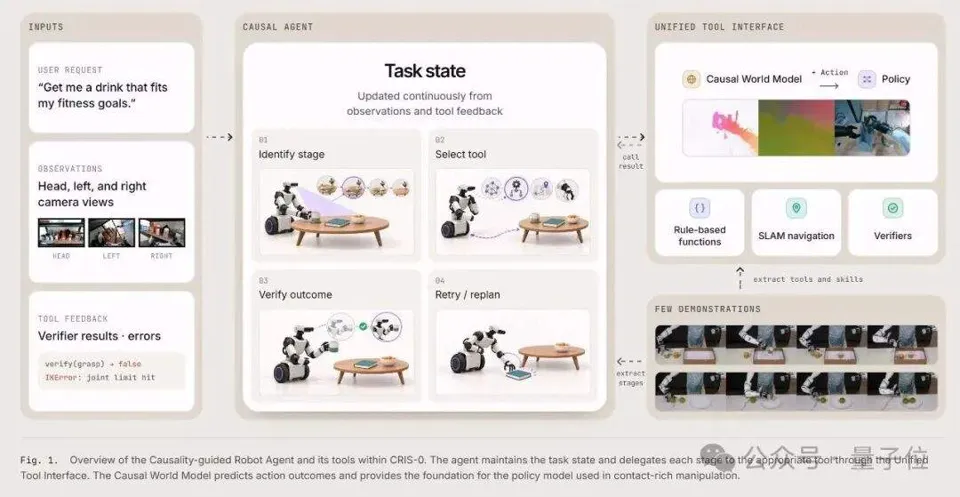
1. Task as State: Extracting Physical Causal Variables
This is the most important first principle in my view.
In the CRIS-0 system, there is a fundamental change called unified state and causal variables.
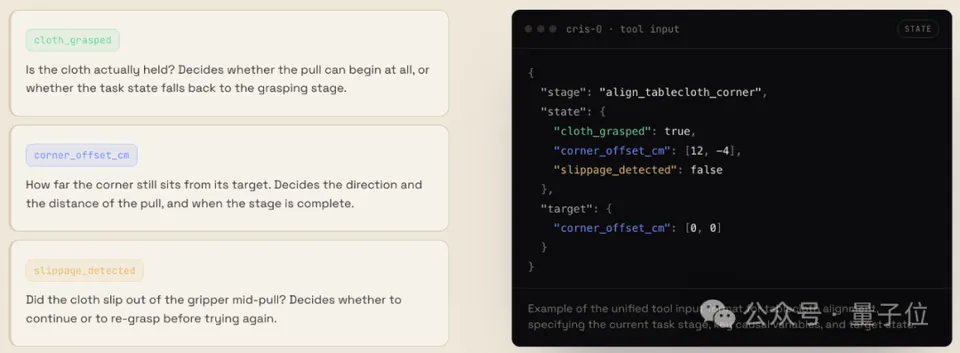
Previous robots viewed the world through dense image pixels. But to CRIS-0, it cares not about what the surface of the world looks like, but about which stage the task has reached. The task itself acts as a causal state progress bar.
Take a very down-to-earth example: a robot laying a tablecloth.
It won’t foolishly calculate the coordinates of every pixel on the entire tablecloth. Instead, it tracks several core causal variables in real-time. For instance, whether the tablecloth is truly gripped by the claw, how many centimeters the corner points are from the target position, and whether slipping occurs during pulling.
Once a grasp slips, the system immediately recognizes that the causal variable "grasp" is no longer satisfied. Consequently, the task state reverts directly to the re-grasping phase, rather than discarding the entire action sequence or blindly continuing to pull at empty air.
In the official coffee-making interference test, faced with frustrating scenarios such as repeated displacement of the coffee machine and sudden changes in lighting, the system identified changes in key variables and completed replanning within an average of 2 seconds. It achieved effective recovery in 9 out of 10 external perturbations.
This demonstrates the power of causal variables: when unexpected events occur, the system clearly knows which step went wrong and where it needs to revert.
2. Unified Tool Interface: Rejecting Single-Strategy Dominance
How exactly does this system execute Actions?
The answer is: Tool Calls, with different tools handling their respective responsibilities.
In its architecture, there is a Planner responsible for overall orchestration, managing a comprehensive toolbox that integrates multiple modules via a Unified Tool Interface.
Rule-based functions: Combine visual localization with inverse kinematics to efficiently handle large-scale spatial displacements and pre-positioning;
Policy models: Specifically tackle high-difficulty contact-rich operations such as pouring water and fine grasping;
Navigation module (SLAM): Responsible for global path guidance;
Verifiers: Execute physical checks at each stage node;
Causal World Model (CausalWM): Responsible for simulating the physical consequences of actions.
Among these, the core killer feature is precisely this Causal World Model.
When many people discuss world models, their first reaction is generating realistic videos of the next few seconds. However, CausalWM in CRIS-0 focuses more on the impact of Actions on the environment.
Its logic is as follows: first observe the current state, then predict which causal variables will change due to candidate actions, and finally derive the future state.
In other words, before the robot reaches out, it is already running simulations in its "mind." For example: If I do this, will my hand slip? Will the cup tip over?
It is equivalent to adding a "rehearsal" step. The system first simulates in the world model, "If I execute Action B, how will the physical causal variables evolve?" Once it confirms the goal can be achieved, it calls the Action Head to output commands to the low-level control.
3. Structured Loop and Native Safety Integration
All of this operates within a continuous loop.
When facing complex tasks, the Planner decomposes the large goal into smaller parts. It first calls rule-based functions to quickly move the gripper near the target, then calls policy models to complete precise contact grasping. Complex problems that were difficult for a single model to solve end-to-end are broken down into several highly deterministic small steps.
Specifically, this involves a dynamically evolving Task Graph: State Recognition → Tool Selection → Execution → Verification → Adjustment.
After each step, the verifier immediately checks whether the physical conditions have been met. If not, the system employs a clear three-tier recovery mechanism: first, determine if a direct retry is possible at this stage; if not, replan the path; if that also fails, prompt for human intervention.
Once an unexpected adjustment succeeds, this successful recovery path is recorded and consolidated into the Task Graph. Next time a similar situation arises, the system becomes more proficient.
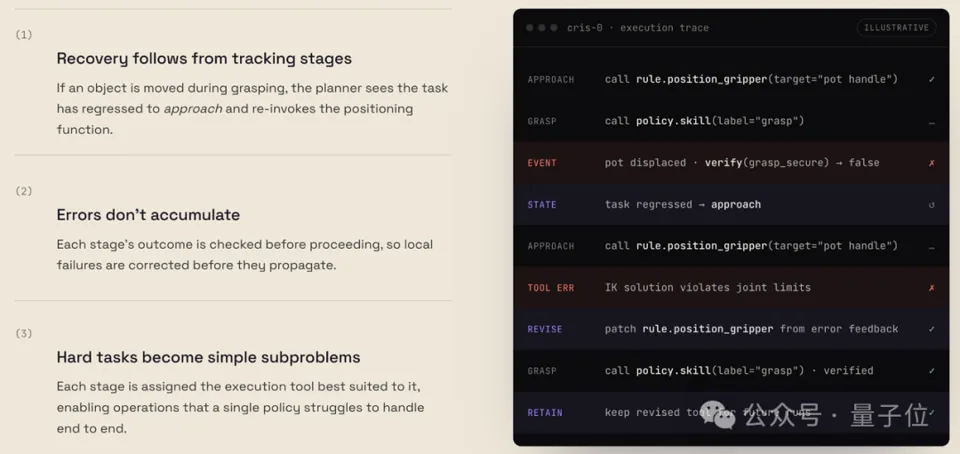
This explains why it can continuously execute dozens or even hundreds of steps without crashing during long-horizon living room tidying tasks.
Because it verifies causal states at every step, errors are resolved locally the moment they arise, preventing them from snowballing into global failures.
Similarly, this is why it achieves a 0.2-second safety emergency stop.
In CRIS-0, safety judgments are directly embedded within each causal stage.
During the door-closing phase, a suddenly appearing human hand constitutes a dangerous variable that violates user safety conditions. The system captures this instantly at the state level and triggers the highest-priority interruption, stopping within 0.2 seconds.
However, if the current task is handing a cup of water to a human, the reaching hand is the interaction target variable, so the system does not stop erroneously.
In fact, the system-level capabilities demonstrated by CRIS-0 did not emerge out of thin air; they are supported by solid research foundations.
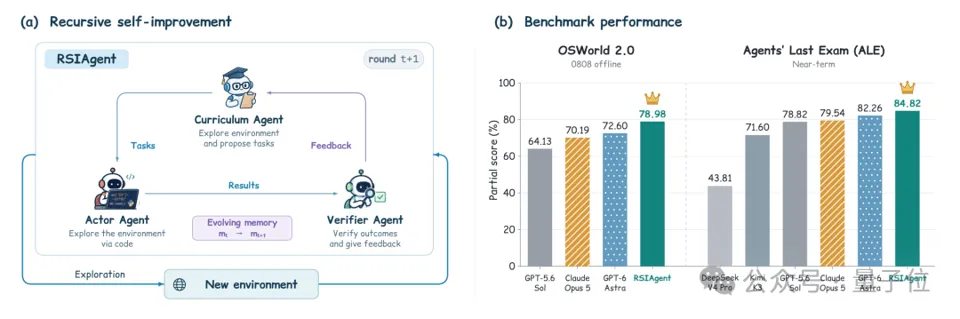
In Agent capability evaluations, Aether AI’s previous causal agent framework, RSIAgent, achieved a Partial Score of 78.98% on OSWorld 2.0. Without updating model parameters, it enhanced the Agent capabilities of open-source models, surpassing closed-source models like GPT-6 Astra.
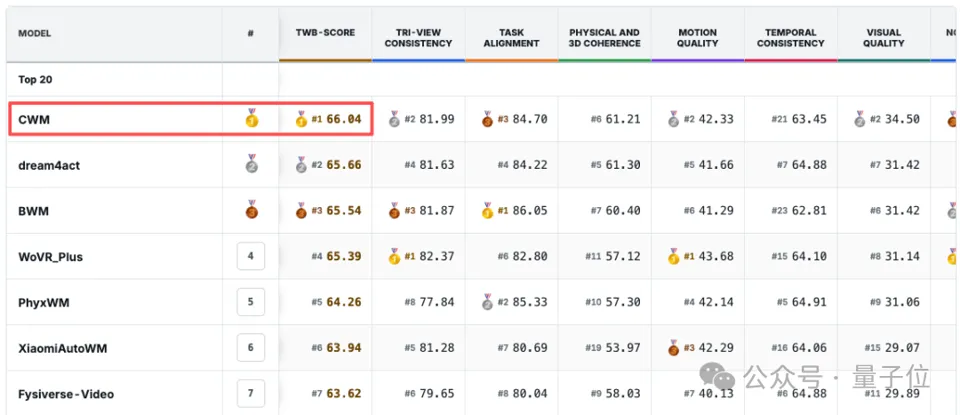
Its first version of the Causal World Model, CausalWM, also topped the Leaderboard on TriWorldBench, a benchmark for robotic world models, achieving Top-1 status.
These two layers are the primary contributors to this Demo.
Additionally, two other layers are under active development: Modular Neural Architecture, where each module corresponds to different causal mechanisms and can be combined or replaced; and Causation Transformer, which learns causal relationships rather than statistical dependencies.

The Physical World Does Not Believe in Rote Memorization
At this point, we can look beyond specific robot demos to gain deeper insight.
Why is causal intelligence being discussed increasingly frequently?
Frankly speaking, the recent explosion of Large Language Models was largely due to luck. Language itself is a modality that has been highly symbolized and abstracted by humans. Many logics and patterns were already summarized by humans on the surface of the text. Directly fitting probabilistic correlations through massive scale ("brute force") worked wonders.
But the physical world does not play by these rules.
Friction does not change because you read 100,000 papers, nor does gravity disappear due to probability statistics. In the real world, filled with complex dynamics, relying solely on fitting superficial correlations will eventually hit the ceiling of Scaling Laws.
In scenarios where physical data is severely scarce, building systems capable of handling complex physical environments requires models to learn like human scientists: extracting underlying causal mechanisms from limited data and understanding exactly how actions alter the world.
This compression structured around the first principles of "causality" may well be the true scaling law for embodied AI.
Of course, this path is exceptionally difficult. Causal discovery and causal representation learning demand rigorous mathematical and statistical theory. Globally, teams possessing both deep theoretical expertise and strong engineering implementation capabilities are exceedingly rare.
Aether AI’s willingness to enter this field is largely tied to its unique academic lineage.
Huang Biwei has dedicated over a decade to this domain. Trained under Clark Glymour and Peter Spirtes—the founders of the CMU causal school—and second-generation scholars Bernhard Schölkopf and Kun Zhang, she is one of the core inheritors of the causal discovery tradition.
The theoretical lineage spanning three generations of the causal school has ultimately converged into the foundational technical pillars of Aether AI today.

From the theoretical accumulation at Carnegie Mellon University and the Max Planck Institute to the tangible realization of CRIS-0 on real robotic arms, causal intelligence has finally taken a critical step toward the physical world.
When a system truly possesses the ability to extract causal variables, model world dynamics, and reason about consequences before acting, its potential extends far beyond simply turning off a microwave or pouring a cup of coffee.
Looking further ahead, this logic could potentially be reused in areas ranging from trend prediction in complex dynamic systems to scientific discovery in fields such as materials science and life sciences.
It is a grand era, friends.
We have long awaited AI that can truly break out of pure digital chat interfaces and stand firmly in this real, complex, and unknown-filled physical world.
And causality may just be the most important key.