新智元 (微信公众号) · 10/10/2026, 08:55:00
OpenAI Releases 175-Page Proof of Four-Dimensional Kakeya Conjecture to Test LLM Reasoning Limits
OpenAI released a batch of 722 mathematical manuscripts on GitHub, featuring a 175-page draft proof for the four-dimensional Kakeya conjecture. This initiative aims to evaluate large language models' capabilities in complex logical reasoning and long-horizon mathematical proof generation, marking a significant shift from general dialogue to specialized scientific discovery.
SOURCE COVERAGEFull Original Report
Wang Hong Conquers 3D; OpenAI Puts the 4D Proof on the Table!
On October 6, OpenAI released its first batch of 722 mathematical manuscripts on GitHub.
One manuscript spans 175 pages and targets the four-dimensional Kakeya conjecture directly.
Another is 97 pages long and aims to push further in three dimensions, targeting a maximal function version stronger than Wang Hong and Zahl’s set theorem.

Group 074 in OpenAI’s mathematical manuscript directory corresponds respectively to the 3D maximal function version and the 4D set version.
This problem, which has pursued mathematicians for over a century, originates from a question that is surprisingly simple.
How can a needle turn around in as small an area as possible?
The Ultimate Turnaround of a Needle
In a crowded train car, turning a closed umbrella by moving it while rotating often takes up less space than simply spinning it horizontally.
In 1917, Japanese mathematician Soichi Kakeya posed a similar problem: For a needle of length 1 with no thickness, what is the minimum area swept when it rotates 180 degrees within a plane?
Besicovitch provided the answer: The area can be arbitrarily small.
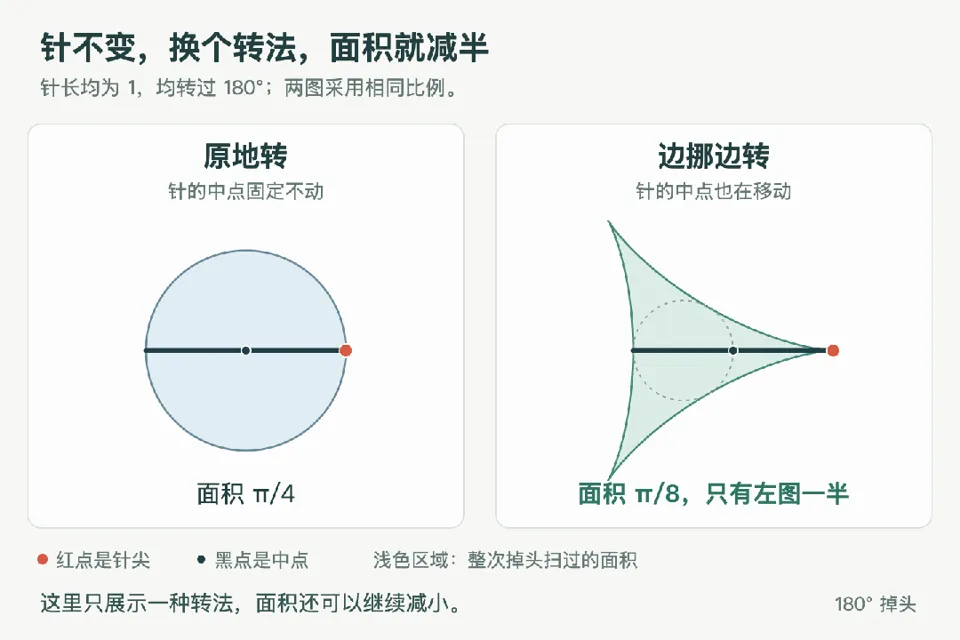
If we relax the requirement further—no longer demanding continuous rotation, but only requiring that a unit line segment fits in every direction—the area of this set can even be zero!
Although the area shrinks to zero, the problem isn’t finished. Do these line segments pointing in all directions still necessarily support a two-dimensional structure?
The Kakeya conjecture asserts: In n-dimensional space, if a set contains unit line segments in every direction, its dimension must be n—that is, it must have "full dimension."
The two-dimensional case was proven in 1971, but in three dimensions, mathematicians remained stuck for more than half a century.
What Did Wang Hong Prove?
To address the three-dimensional problem, mathematicians first thicken these line segments slightly into thin tubes, then observe how the volume changes as the tubes become thinner and overlap.
Over twenty years ago, Katz, Łaba, and Terence Tao discovered some exploitable arrangement patterns.
However, bundles of tubes that appear densely packed from a distance may contain significant gaps when magnified, so they cannot be treated directly as solid thick tubes for calculation. Results at different scales do not necessarily connect seamlessly.
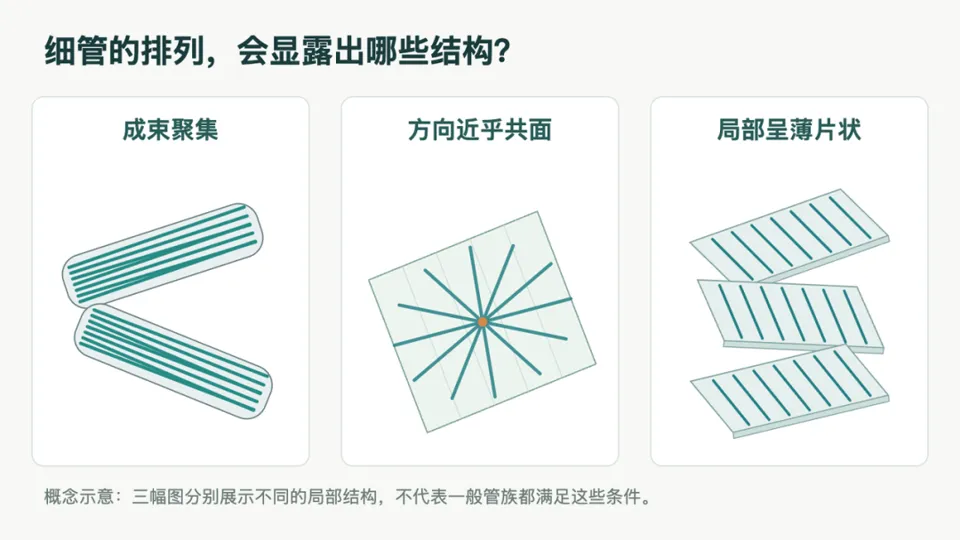
To solve this issue, Wang Hong and Zahl started with the more regular "sticky" case, completing the proof in 2022.
In February 2025, the pair submitted a 127-page paper, finally advancing the proof to the general case.
The three-dimensional "set version" of the conjecture was thus officially resolved.
Wang Hong and Zahl’s paper on the 3D Kakeya conjecture concludes in the abstract that both the Hausdorff dimension and the Minkowski dimension are 3.
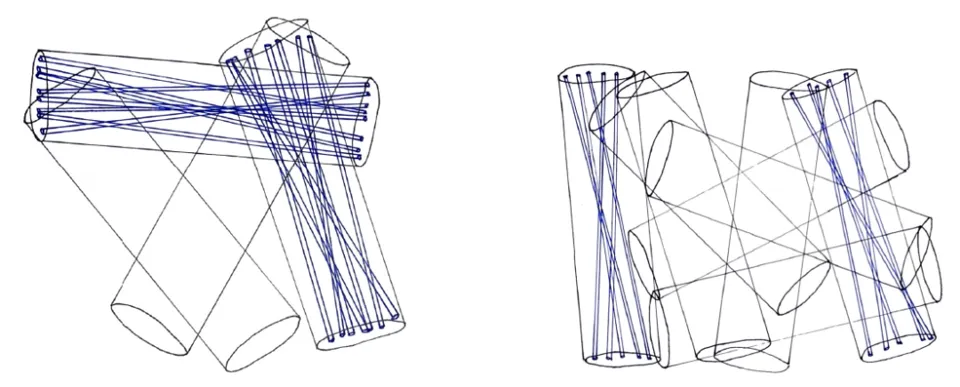
Left image: The "sticky" case; Right image: Thick tubes heavily overlapping, yet the internal thin tubes remain sparse.
OpenAI’s New 3D Proof
Same Problem, Stronger Version
Three dimensions have been conquered, but the challenge isn’t over.
While Wang Hong and Zahl solved the dimensional problem for sets, the more demanding "maximal function version" still awaits an answer.
OpenAI’s 97-page manuscript targets precisely this next step.
Title and abstract of OpenAI's three-dimensional manuscript; the main theorem targets the stronger Kakeya maximal function conjecture.
The difference lies in how the thin tubes are colored. Each tube is only partially colored, and overlapping regions are counted only once. What is the minimum volume occupied by these colors combined?
The estimates by Hong Wang and Zahl were already sufficient to prove that "the dimension is 3." OpenAI aims to go further, precisely controlling the relationship between the coloring ratio and the total volume. Even if less area is colored, this stricter lower bound must still hold.
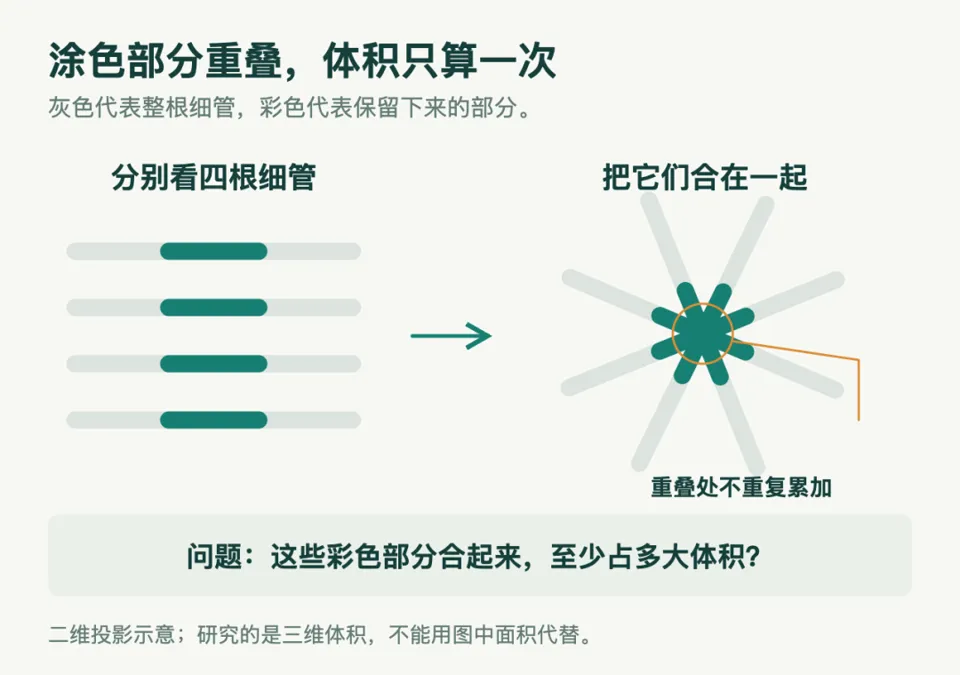
According to OpenAI's argument, this stricter requirement is satisfied, allowing them to derive the complete three-dimensional maximal function estimate.
The difficulty arises after scaling up.
If you color the same 10%, concentrating it at one end versus distributing it across various locations can result in completely different densities when a small segment is cut out.
OpenAI therefore records the distribution of coloring across different scales, tracking changes during each subdivision and scaling step. By combining geometric estimates with entropy analysis, they attempt to rule out configurations where excessive overlap violates the target lower bound.
This argument still relies on set estimates by Guth, Hong Wang, and Zahl, as well as the planar Furstenberg theorem by Hong Wang and Kang Ren.
If the main theorem holds, the benefits extend beyond just this result.
- One category involves Nikodym maximal function estimates, shifting from searching for thin tubes along specific directions to studying thin tubes passing through individual points.
- Another category leverages existing transformation theorems to generalize conclusions from straight thin tubes to curved thin tubes satisfying specific conditions, yielding corresponding local results.
OpenAI's New Four-Dimensional Proof
Adding one dimension increases difficulty by more than just one level
Previous lower bounds for dimension stalled at 3.059; Hong Wang and Zakharov's breakthrough achieving full dimension in September of this year only covered special "sticky" cases.
Jumping from 3.059 directly to 4! This 175-page manuscript by OpenAI challenges exactly this step.
Title and abstract of OpenAI's four-dimensional Kakeya manuscript. The main conclusion concerns the Hausdorff dimension of general four-dimensional Kakeya sets.
However, the three-dimensional proof cannot be directly transplanted to four dimensions.
Guth pointed out that in four dimensions, thin tubes can cluster heavily along quadratic surfaces, creating overlaps that three-dimensional methods fail to control.
OpenAI thus treats this clustering itself as a clue. They use quadratic polynomials to describe local line segment relationships and track how far these relationships can extend along the segments.
But explaining a few line segments is not enough.
OpenAI utilizes a weighted estimate from the earlier 97-page three-dimensional manuscript to ensure that the selected local regions contain sufficiently many intersections of line segments.
The source of this lemma remains the set estimates by Guth, Hong Wang, and Zahl.
Page 20 of OpenAI's three-dimensional manuscript, Lemma 3.3 and Equations (3.7), (3.8); cited as "Lemma 2.3" in the four-dimensional draft, and restated in its own Lemma 2.15.
When handling planar structures, OpenAI's four-dimensional argument also employs the dot product theorem by Hong Wang and Zahl.
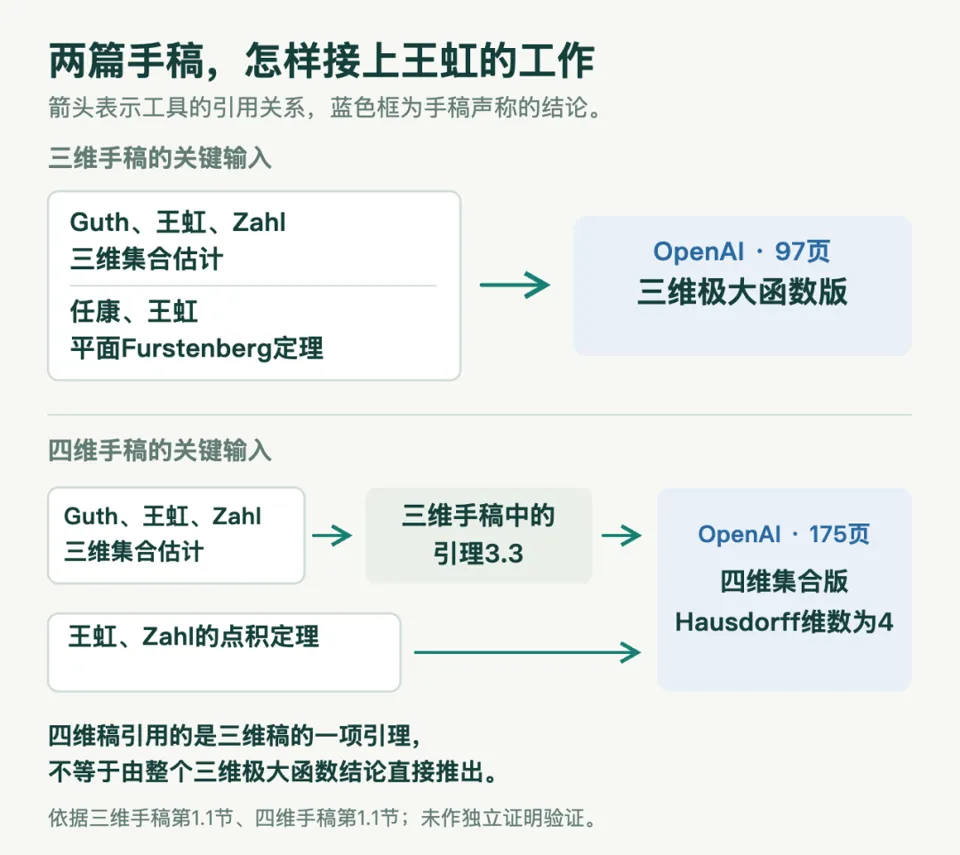
This resembles unlocking a tech tree: as OpenAI progresses further, they still rely on prerequisite skills unlocked with Hong Wang's involvement.
The final step requires hypothetical counterexamples to reveal their own flaws.
OpenAI first assumes the existence of a Kakeya set with a dimension less than 4, then handles cases based on how line segments cluster. Some scenarios allow local relationships to extend further along the segments, while others confine segments to thinner regions.
Next, these improvements must be connected, ensuring they remain valid when scaled back to the original size. According to OpenAI's argument, this leads to a conflict with the conditions that the hypothetical counterexample must satisfy, thereby ruling out the possibility of a dimension less than 4.
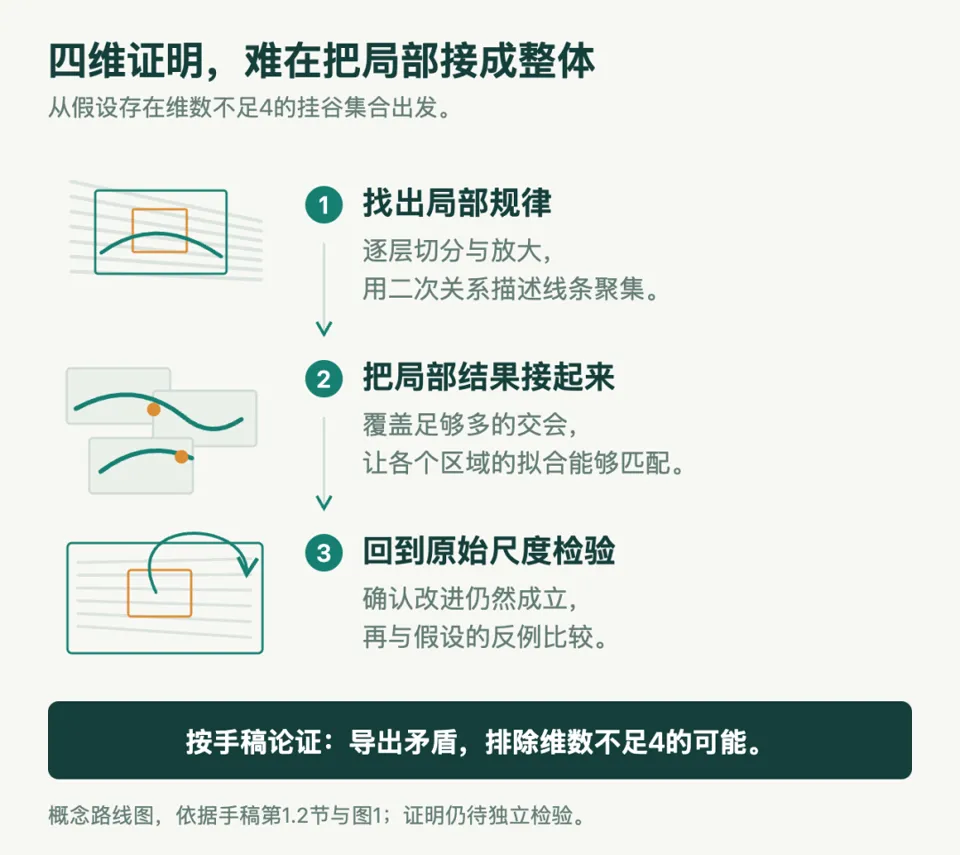
If these 175 pages withstand scrutiny, the full-dimensional conclusion for four dimensions will advance from a special case to the general case. As long as unit line segments in all directions are present, the Hausdorff dimension of the set must be 4.
However, this remains the "set version" of the four-dimensional result. The stronger four-dimensional maximal function version has not yet been resolved by this work. For five dimensions and above, we have only established that the dimension is at least 4; we cannot yet deduce full dimensionality for those cases.
The Last Fields Medal Belonging to Humans?
So here is the question: Will this year’s ceremony be the last Fields Medal belonging to humans?
Only months after Wang Hong received her medal, OpenAI submitted a new 272-page manuscript on the same research direction. Both proofs still require independent verification. But if they ultimately hold up, future accounts of this mathematical history will inevitably mention OpenAI.
Wang Hong’s name has not faded from the narrative either. As OpenAI pushes forward, it continues to rely on the estimates and methods established by her and her collaborators.
What truly hangs in the balance is the next breakthrough. If AI begins to consistently propose new methods and open new directions, can humans continue to take the lead step every time?
By 2030, when the next Fields Medal is awarded, the question worth asking may not just be who stands on the podium.
It may also be who conceived the most critical step in the award-winning achievement.
References:
Chasing ASI Instantly
⭐ Like, Share, and Watch – One Click Triple Combo ⭐
Star us to lock in instant updates from New Intelligence!